Are you struggling to balance privacy with an open, collaborative office culture? You are not alone. Modern businesses face a common dilemma: how to create quiet zones without building claustrophobic, light-blocking drywall boxes.
The solution is almost always glass—but that leads to a tougher question: Framed or Frameless?
This decision impacts more than just aesthetics; it dictates your budget, office acoustics, and long-term maintenance. In this comprehensive guide, we will break down the framed vs frameless glass partitions debate, helping you choose the perfect system to future-proof your workspace.
What’s the Difference? At a Glance
Before we dive deep, here is the high-level distinction between the two systems.
- Frameless Glass Partitions: These systems rely on minimal hardware (usually top and bottom channels or clamps). The glass panels are butt-jointed with clear silicone or dry joints, creating a seamless “wall of glass” effect.
- Framed Glass Partitions: These feature visible framing—typically aluminum or steel—around each glass panel. The frame provides structural support and often creates a grid-like, industrial aesthetic.
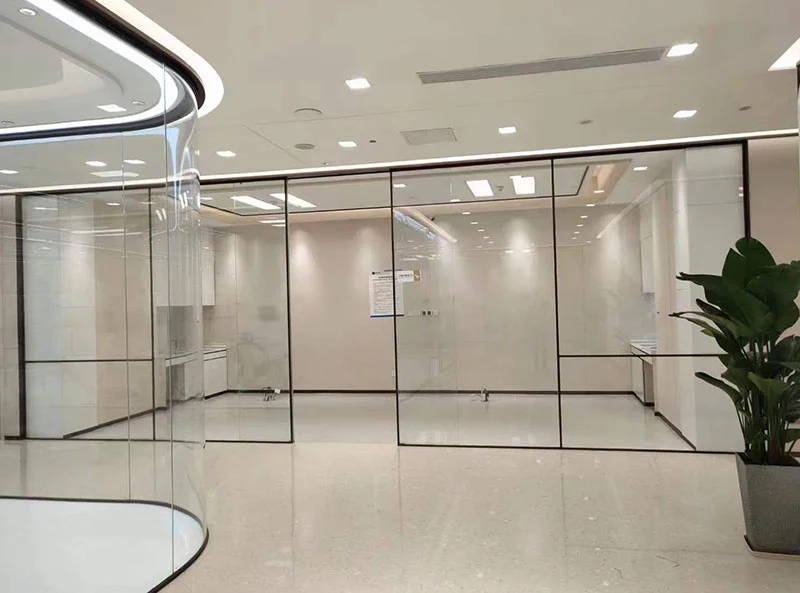
Frameless Glass Partitions: The Modern Minimalist
Frameless partitions are the darling of modern interior design. They are designed to be invisible, allowing light to flood through the office.
The Pros
- Aesthetics: Unmatched elegance. They make small offices feel expansive and high-end.
- Maximum Light Flow: With no vertical posts to block the sun, natural light reaches deeper into the building.
- Clean Lines: Ideal for “agile” workspaces that want to avoid visual clutter.
The Cons
- Acoustics: Generally offers lower sound insulation than framed systems because sound can leak through the tiny gaps between panels (though acoustic glazing can mitigate this).
- Cost: Surprisingly, “less” often costs more. The glass must be thicker (typically 10mm-12mm toughened or laminated) to support itself without a frame.
- Fragility: Exposed edges can be chipped if hit by furniture or cleaning equipment.
Framed Glass Partitions: The Industrial Workhorse
Framed systems are making a massive comeback, driven by the “Crittall-style” black-framed industrial trend. They are robust, practical, and highly versatile.
The Pros
- Superior Acoustics: The frame allows for tighter seals on all sides, significantly reducing sound leakage.
- Structural Integrity: The metal skeleton supports the glass, meaning you can often use thinner, less expensive glass panels.
- Design Versatility: You can customize the frame color (anodized aluminum, matte black, white) to match your brand identity.
- Demountability: Many framed systems are modular, meaning you can take them down and move them if your lease ends or your team grows.
The Cons
- Visual Obstruction: Vertical frames break up the view.
- Bulky Feel: In very small rooms, heavy frames can make the space feel smaller than it is.
Cost Comparison: What’s the Real Price Tag?
Budget is often the deciding factor. Below is a glass partition price comparison to help you estimate your project.
| Feature | Framed Partitions | Frameless Partitions |
| Material Cost | $$ (Lower) | $$$ (Higher due to thicker glass) |
| Installation Labor | $$ (Standard) | $$$ (Requires high precision) |
| Glass Thickness | 6mm – 10mm | 10mm – 12mm+ |
| Est. Cost (per sq. ft.)* | $$ (Lower) | $$$ (Higher due to thicker glass) |
> Note: These are estimated market averages. Prices vary based on height, door types (sliding vs. hinged), and acoustic requirements.
Aluminium Office Partition Cost Factors
If you opt for framed systems, aluminium office partition costs are generally the most efficient. Aluminum is lightweight, rust-resistant, and cheaper to extrude than steel. However, adding “acoustic” or “double-glazed” specifications to an aluminum frame will jump the price by 20-30%.
Critical Factors: How to Decide
Don’t just choose based on looks. Consider these functional realities of your office.
1. Acoustic Needs (Soundproofing)
If you are building a designated Zoom room or HR office, framed is safer.
- Framed: STC (Sound Transmission Class) ratings often range from 35 to 45+ (with double glazing).
- Frameless: Standard single-glazed frameless walls usually hit 30 to 33 STC. You can get higher ratings with specialized acoustic laminate, but it gets expensive fast.
2. Floor Levelness
This is a hidden “gotcha.”
- Frameless systems require perfectly level floors and ceilings. If your floor dips even slightly, the glass panels won’t align, leaving ugly gaps.
- Framed systems are more forgiving. The channels can often hide uneven tolerances in the building structure.
Office Glass Wall Installation: Common Mistakes

As an expert in the field, I see clients make the same errors repeatedly. Avoid these to save your budget.
Mistake #1: Ignoring HVAC and Lighting
The Issue: You install a beautiful glass wall, but now the thermostat is on the outside, or a ceiling vent is blowing air directly onto the glass, causing condensation or uneven temperatures.
The Fix: Consult your HVAC plan before finalizing the partition layout.
Mistake #2: The “Fishbowl” Effect
The Issue: Employees feel exposed and watched, which kills productivity.
The Fix: You don’t need to abandon glass. simply apply manifestations (frosted film decals) at eye level. This satisfies safety regulations and adds privacy without blocking light.
Mistake #3: Door Hardware Compatibility
The Issue: Trying to install a heavy smart-lock system on a frameless glass door.
The Fix: Frameless doors require specialized patch fittings.17 If you need complex access control (keypads, magnetic locks), a framed door is infinitely easier to wire and secure.
Expert Tips for a High-End Finish
- Double Glazing for Directors: If budget allows, use double-glazed frameless systems for executive offices. It gives you the “frameless look” with the “framed soundproofing.”
- Black is the New Neutral: Matte black aluminum frames hide fingerprints better than chrome and frame the view like a picture, actually enhancing the aesthetic rather than cluttering it.
- Check the “Iron” Content: For frameless glass, ask for “Low-Iron” glass. Standard glass has a slight green tint at the edges. Low-iron glass is crystal clear, making the partition truly invisible.
Conclusion
Choosing between framed vs frameless glass partitions comes down to your priority: Acoustics vs. Aesthetics.
- Choose Frameless if: Your top goal is light, style, and an open vibe, and you are willing to pay a premium for thicker glass.
- Choose Framed if: You need robust sound privacy, have a tighter budget, or want that trendy industrial grid look.
Both options are superior to drywall, increasing property value and employee well-being.